









For months, European waters were quiet. A year earlier, several undersea cables had been damaged by cargo ships, but after the rapid launch of NATO’s Baltic Sentry mission, incidents declined quickly. NATO cautiously marked its successes, and calm appeared to be returning. Until the final day of the year.
That day the Finnish Navy detained a ship and its crew after a cable between Finland and Estonia was damaged.
Follow us on: Telegram (new), Bluesky, X or Linkedin
It almost appeared to be a trend. After the deployment of naval vessels in the Baltic Sea as part of the protection mission Baltic Sentry, undersea incidents seemed to disappear overnight. For months, cable breaks caused by cargo ships from Russia’s suspected shadow fleet dominated the headlines. Then, suddenly, drones appeared over airports. Once again, NATO countries faced a new challenge on their own continent, forcing the alliance to shift its focus to a different domain. Not underwater, but in allied airspace.
Too silent?
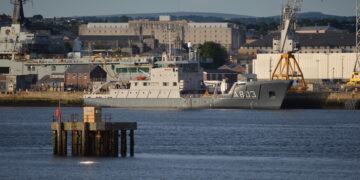
During all those months, ships from various European navies patrolled the Baltic Sea. The Netherlands, Sweden, US, Germany, France and Estonia contributed to security efforts and sailed alongside suspicious vessels. In November, NATO itself wrote proudly about the effects of the operation.
“Since Baltic Sentry began in January 2025, there have been no maligned damage to critical undersea infrastructure in the Baltic Sea. Baltic Sentry underscores NATO’s unwavering commitment to security and resilience in a region facing an increasingly complex operating environment”, NATO wrote.
Lowered anchor
After that, it remained quiet. So quiet that, towards the end of the year, we were working on an article questioning whether the firm show of force represented by Baltic Sentry had truly been a success. On the last day of the year, the cargo ship Fitburg disrupted that narrative.
The cable damage occurred in Estonian waters, but the vessel was seized by Finnish authorities near the Finnish coastline. Notably, the ship was sailing with a lowered anchor, which is believed to have damaged the cable in Estonia. According to MarineTraffic, the ship originated from St Petersburg and has remained stationary since.
Accident or deliberate?
Was it an accident, or was the anchor deliberately dragged across the seabed cables? This remains a difficult question to prove in such cases, fitting the nature of hybrid warfare in the grey zone between peace and war.
Dragging anchors or fishing gear — also known as anchoring — accounted for 86 percent of global undersea cable damage in 2024. The incidents in the Baltic Sea, however, stood out. In a short period last year, several cables were damaged by cargo ships travelling to or from Russia. In none of the cases was hard and direct evidence of malicious intent found, but the short timeframe in which the incidents occurred suggests a different story.
“Launchpad for hybrid attacks”
In the case of the telecom cable cut on the final day of the year in Finland, there is also no conclusive proof. Nevertheless, Kaja Kallas, High Representative for Foreign Affairs and Security Policy of the European Commission, is strongly pointing towards Russia.
“The Baltic Sea has seen a clear pattern of disruption since the start of Russia’s war. Europe’s critical infrastructure remains at high risk of sabotage. I thank Finland for taking swift and determined action in seizing the ship and crew suspected of damaging subsea cables yesterday,” Kallas wrote on X.
“The EU will continue to fortify its critical infrastructure, including by investing in new cables, strengthening surveillance, ensuring more repair capacity, and moving against Moscow’s shadow fleet, which also acts as a launchpad for hybrid attacks.”
It makes clear that NATO’s naval vessels in the Baltic Sea are facing a long-term mission.